¿Va primero el verbo? OR ¿El sujeto va primero?: Subject-verb order in Latin American Spanish
Jul 1, 2023·
Lee-Ann Vidal Covas
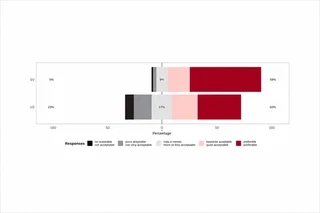 Word Order Ratings. Figure shows that, overall, SV order is highly preferable (86%) compared to VS order which is rated as preferable only 60% of the time. SV order is only dispreferred 5% of the time, whereas VS is rated negatively 23% of the time.
Abstract
This paper investigates subject-verb placement for unaccusative and unergative verbs in Spanish, focusing on syntactic, pragmatic, and sociolinguistic factors that predict placement.
The study aims to answer three questions:
(1) Does the unergative/unaccusative divide influence SV/VS order acceptability?,
(2) What are the dialectal differences in subject placement acceptability in Spanish?, and
(3) Does sentence context affect subject placement preference?
The study collected data from sixty-nine Spanish speakers from the Caribbean, Chile, and Mexico, who provided 1656 acceptability ratings on sentences with different subject-verb orders. The findings indicate that both verb type and pragmatic conditions predict word preferability, with VS order preferred when the verb is unaccusative, and SV order preferred overall. The study adds to the literature by establishing the connection between argument structure and information structure and supporting the Unaccusative Hypothesis.
The study aims to answer three questions:
(1) Does the unergative/unaccusative divide influence SV/VS order acceptability?,
(2) What are the dialectal differences in subject placement acceptability in Spanish?, and
(3) Does sentence context affect subject placement preference?
The study collected data from sixty-nine Spanish speakers from the Caribbean, Chile, and Mexico, who provided 1656 acceptability ratings on sentences with different subject-verb orders. The findings indicate that both verb type and pragmatic conditions predict word preferability, with VS order preferred when the verb is unaccusative, and SV order preferred overall. The study adds to the literature by establishing the connection between argument structure and information structure and supporting the Unaccusative Hypothesis.
Type
Publication
Proceedings of the Linguistic Society of America, 8(1). 5542
Optional Extended Content
Latin American Spanish
Subject-Verb Order
Intransitive Verbs
Unaccusative Verbs
Unergative Verbs
Regional Dialects
Sociosyntax
Spanish Language
Morphosyntax

Authors
Lee-Ann Vidal Covas
(she/her)
Language Scientist (PhD, Boston University) with expertise in sociolinguistic research, dataset curation, and applied data science.