What we say when we say nothing at all: Clues to contact-induced language change in Spanish conversational pause-fillers


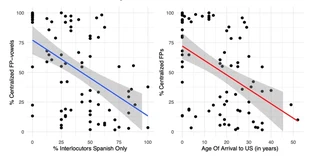 Rate of Centralized FP-vowel by Percent Interlocutors Spanish Only and Age of Arrival.
Abstract
The present paper examines variation in the vowel quality of filled pauses produced by 80 Spanish-speaking residents of Boston, MA in the context of sociolinguistic interviews. Statistical analysis reveals patterns consistent with contact-induced language change: Individuals who arrived to the U.S. as adults and who speak exclusively Spanish with most of their interlocutors (i.e., family, friends, and coworkers) strongly prefer to fill pauses in spontaneous Spanish speech with eh/em. In contrast, those who were born in or arrived to the U.S. as children and/or who speak exclusively Spanish with fewer interlocutors are significantly more likely to use ah/am and uh/um. We interpret this difference as evidence of a rearrangement of pausing-filling norms among those with greater experience using English. Our results align with a view of language contact as a potential catalyst of linguistic innovation, one that is tightly constrained by the structure of linguistic systems.
Type
Publication
Observatorio Studies, 80, pp. 1- 29

Authors
Daniel G. Erker
(he/him)
Associate Professor
Variationist Sociolinguist and an Associate Professor in the Department of Linguistics at Boston University

Authors
Lee-Ann Vidal Covas
(she/her)
Language Scientist (PhD, Boston University) with expertise in sociolinguistic research, dataset curation, and applied data science.