Word Order & Information Structure in Latin American Spanish
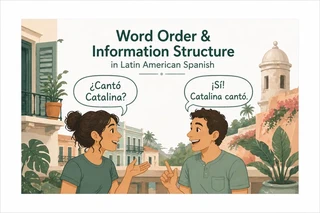
How do Spanish speakers judge Subject-Verb (SV) vs. Verb-Subject (VS) word orders—and how do verb type (unergative vs. unaccusative) and pragmatic condition (wide focus, subject-narrow focus, subject-given) shape those judgments? Using a controlled, online experiment, I test links between argument structure and information structure in four Latin American dialects.
At a glance
| Design | Online acceptability-judgment task (Likert 1–5), 2×3 (Verb Type × Pragmatic Condition) | |
| Survey Hosting Platform | Qualtrics | |
| Recruitment | Prolific | |
| Participants | N = 69 (Chile, Cuba, Mexico, Puerto Rico) → 1,656 ratings (SV/VS) | |
| Methods | Mixed-effects modeling in R |
Key findings
- SV preferred overall; VS favored with unaccusatives.
- Verb type and pragmatic condition jointly predict acceptability.
- Region not predictive in these data.
- Supports a link between argument structure & information structure (Unaccusative Hypothesis).

Authors
Lee-Ann Vidal Covas
(she/her)
Language Scientist (PhD, Boston University) with expertise in sociolinguistic research, dataset curation, and applied data science.