Subject Pronoun Expression in Puerto Rican Spanish
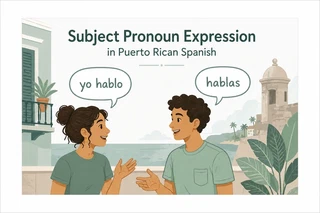
In Spanish, finite verbs can occur with or without an expressed subject pronoun — as in yo hablo ‘I speak’ vs. hablo ‘(I) speak’ — without altering the meaning. Drawing on sociolinguistic interviews from Puerto Rican speakers in Louisiana and Puerto Rico, I examine how grammatical and discourse constraints pattern this variation. Results reveal Caribbean-typical pronoun rates (~37%) and show that internal morphosyntactic factors, not English contact, drive pronoun use in this sample.
At a glance
| Design | Sociolinguistic interviews with 20 speakers (≈2,300 tokens); analyzed with Goldvarb |
| Predictors | Person/number, switch-reference, tense–mood–aspect, prior-subject realization, clause type, and verb semantics |
| Timeline | Conducted at Louisiana State University; later informed dissertation research expanding the same variable to new samples and contexts |
Key findings
- Pronoun rates ≈ PR 37.8% vs. LA 37.0%.
- 1SG/3SG and switch-reference favor pronoun usage; plurals disfavor it.
- Only location shows a clear social effect — routine English contact did not increase pronoun usage.

Authors
Lee-Ann Vidal Covas
(she/her)
Language Scientist (PhD, Boston University) with expertise in sociolinguistic research, dataset curation, and applied data science.