Filled Pauses & Language Contact in Boston Spanish
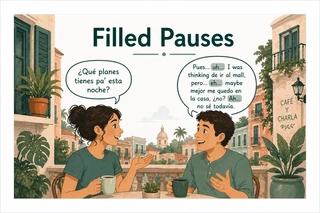
When people speak, they often pause with short sounds like uh, ah, or eh while planning what to say next. These filled pauses keep the conversational floor and help listeners follow along—yet they vary across languages. English speakers tend to say uh/um, while Spanish speakers more often use eh/em. This project investigates how bilingual Spanish speakers in Boston use these tiny hesitation sounds, revealing how everyday speech encodes patterns of language contact and sound change.
At a glance
| Design | Sociolinguistic interviews from the Spanish in Boston Corpus | |
| Speakers | Spanish-speaking Bostonians (N=80, ≈6,364 tokens, 13 national origins) | |
| Methods | Acoustic analysis in Praat Mixed-effects modeling in R | |
| Predictors | Age of arrival, language use with interlocutors, and phonetic context | |
| Variable | Vowel quality in filled pauses — fronted [e] (eh) vs. centralized [a]/[ə] (ah, uh) |
Key findings
- Speakers with greater English exposure (earlier arrival, more bilingual networks) favor centralized pauses ([a], [ə]), while Spanish-dominant speakers prefer [e].
- Phonetic context plays little role — the pattern is socially, not structurally, driven.
- The shift is conservative: bilinguals reorder pause-filling norms rather than adopting English-like forms wholesale.

Authors
Lee-Ann Vidal Covas
(she/her)
Language Scientist (PhD, Boston University) with expertise in sociolinguistic research, dataset curation, and applied data science.