Covariation & Salience in Linguistic Contact
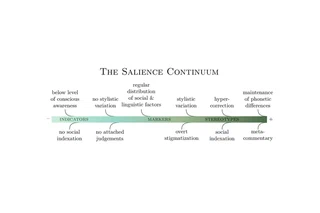
I investigate how the noticeability—or salience—of different linguistic features shapes how people use and adapt language in contexts of contact with other dialects and languages. Instead of analyzing features one by one, I look at how lower- and higher-salience features pattern together to understand when speakers converge toward another language, maintain their own patterns, or repurpose features as identity markers. This approach bridges morphosyntax, phonetics, and discourse, integrating reproducible annotation and quantitative modeling across multiple feature types.
Future work expands this framework by adding more higher-salience variables (e.g., intervocalic /d/ lenition, vowel lowering, prosodic “cantadito”) and by including new communities beyond Boston as well as additional national identity groups. By comparing both speech production and listener perception, I explore when bilingual speakers adapt for efficiency and when they preserve differences as a form of cultural expression.
Dissertation Research
Conducted as part of the Spanish in Boston Project (NSF BCS-1423840), my dissertation examines how lower- and higher-salience features co-vary in the speech of Puerto Rican and Dominican Bostonians. Using mixed-methods analysis, I show that lower-salience features—like subject-pronoun expression, subject placement, and filled pauses—tend to align with English-compatible patterns, while higher-salience features—such as coda /s/ and liquids (/r, ɾ, l/)—remain socially meaningful resources. The results demonstrate that salience—social as much as perceptual—explains which variables shift together and which persist as identity markers.
At a glance
| Scope | Covariation across morphosyntax (pronouns, word order), discourse (filled pauses), and phonology (coda /s/, liquids) | |
| Design | Sociolinguistic interviews from the Spanish in Boston Corpus plus metalinguistic commentary | |
| Speakers | Puerto Rican and Dominican speakers (N=22, ≈24,197 tokens) | |
| Methods | Acoustic analysis in Praat Mixed-effects modeling in R |
Key findings
- Lower-salience features show modest, systematic convergence with English norms (bilingual optimization).
- Higher-salience features remain stable & socially indexed, marking national identity distinctions.
- Salience is continuous and ideologically mediated, structuring which variables shift together and which become identity markers.
