Application Build System: Modular LaTeX & AI Workflow Automation
Overview
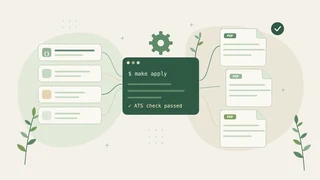
Applying for roles in research, tech, and international organizations means producing many tailored documents that all have to stay accurate, consistent, and readable by applicant-tracking systems. I turned that work into a build system: documents are assembled from reusable, version-controlled modules, and AI agents take over the checks that used to be manual.
Stage 1: Modular LaTeX (before AI tools)
- Built a cover-letter system on two axes, inspired by my partner’s simpler version: a mode (academia, postdoc, tech, consulting, international organizations) selects the generic paragraphs, and a short per-application file supplies the employer details
- Extended that per-application file to drive my research and teaching statements and writing samples, so one form controls every document in an application
- Any paragraph can be replaced for a single application; if the replacement is left empty, the generic version is used automatically
- Wrote optional-field macros so a blank field (team, department, job reference) disappears cleanly instead of leaving stray words
- Compiled from VS Code with a Makefile and latexmk, with no separate LaTeX editor; combined packets merge the letter, statements, and CV into one PDF
- A new tailored letter meant filling in one short file instead of rewriting a whole document
Stage 2: AI Agents & Skills (Claude Code)
- ATS review skill: a Python checker scans each built PDF for text-extraction hazards (ligatures, icon glyphs, footer text interleaving with the body, section headings); the agent then traces each finding to its source line and fixes it only on approval
- Repo-sync skill: screens every change for credentials and personal records, groups the rest into logical commits, shows the plan for approval, and pushes without ever force-pushing
- Profile & drafting agents: maintain a verified professional profile and writing voice, and suggest cover-letter edits grounded in the verified facts in that profile; I review every suggestion and decide what goes in
Design Principles
- Write once, reuse everywhere: each paragraph and field is written once and reused, so documents stay consistent
- Human in the loop: agents propose, I approve
- Reproducible: every document rebuilds from version-controlled source with one command

Authors
Lee-Ann Vidal Covas
(she/her)
Language Scientist (PhD, Boston University) bridging sociolinguistic research and AI, with expertise in model evaluation, dataset curation, and applied data science.